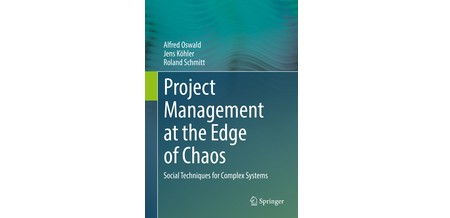
Project Management at the Edge of Chaos
The headline seems to be a contradiction. Project management is typically perceived to be structured, keeping order and being the opposite of chaos. However, the authors of “Project Management at the Edge of Chaos”, Alfred Oswald, Jens Köhler and Roland Schmitt, saw a gap in the management dealing with theories and models in complex contexts, e.g. as required for complex projects. Thus, they have published a book, taking a completely new approach and transferring the principles of self-organization as described in the theory of Synergetics, from the natural sciences to leadership of organizations and projects. Individuals and their interactions in projects are the center of the authors´ attention. They make transparent their behaviour, motives, needs, temperament and culture, including their mutual dependencies…
The book builds on the assumption that project management can be understood as social technology which uses theories, models and methods for shaping and leading temporary organizations. Three complexity drivers in projects, i.e. task (scope), stakeholders and social organizations, and environment (context), cause an interconnectedness of social and technical systems with the respective complex dynamics in the social-technical realm. As two of the three authors are Physicists, they quickly start connecting “complexity” with the term of “entropy”, which might be (mistakenly) associated with disorder or chaos. In a complex (social) system however, under certain conditions, a new dynamic macro-state may develop by self-referentiality (refers to the ability of a system to create a reference for itself, in order to distinguish it from its environment, The ability for self-referentiality is an important precondition for self-organization.
What can a project manager do in order to deal with complexity? One option is to (“shielding in space and time”) control the flow of social complexity in and out of a temporary organization “project”, or regulating through the formation of models and intuition, through targeted interconnectedness and social self-organization, or through organizational setting, control and order parameters.
Based on the theoretical considerations, the book focuses on leadership in complex social systems, social techniques such as mindfulness (see also: http://blog.ipma.world/mindfulness-projects-fashion-fiction-mastery/) and adaptive management systems. The latter requires mindsets such as Lean Thinking, Agile Organizations, Critical Chain Methods and Innovation. Organisations and their environment increasingly form an interactive relationship, organizations typically need to adapt to the context they are operating in. In future, the ability of flexibility and speed (“agility”) of an organization will play a key role in a volatile environment. In the book those organizations are called “fluid”. Such an organizational network consists of parent organization(s), process-oriented permanent organizations and project-oriented temporary organizations which typically adapt to the environment. Such an organization must significantly increase its ability to transform, otherwise friction between the different organizations will lead to the opposite effect: emotional blockages, stress, chaos …

Reinhard Wagner has been active for more than 30 years in the field of project- related leadership, in such diverse sectors as Air Defense, Automotive Engineering, and Machinery, as well as various not-for-profit organizations. As a Certified Projects Director (IPMA Level A), he has proven experience in managing projects, programmes and project portfolios in complex and dynamic contexts. He is also an IPMA Certified Programme and Portfolio Management Consultant, and as such supports senior executives in developing and improving their organizational competence in managing projects. For more than 15 years, he has been actively involved in the development of project, programme and portfolio management standards, for example as Convenor of the ISO 21500 “Guidance on Project Management” and the ISO 21503 “Guidance on Programme Management”. Reinhard Wagner is Past President of IPMA and Chairman of the Council, Honorary Chairman of GPM (the German Project Management Association), as well as Managing Director of Tiba Managementberatung GmbH.
Topics of interest
Most Read
-
 15 June 2018 | 7:26
5Ws 1H: A technique to improve Project Management Efficiencies
-
 29 January 2018 | 8:13
5S (or 6S) Lean Management technique: Possible uses in project management
-
 02 February 2018 | 2:32